
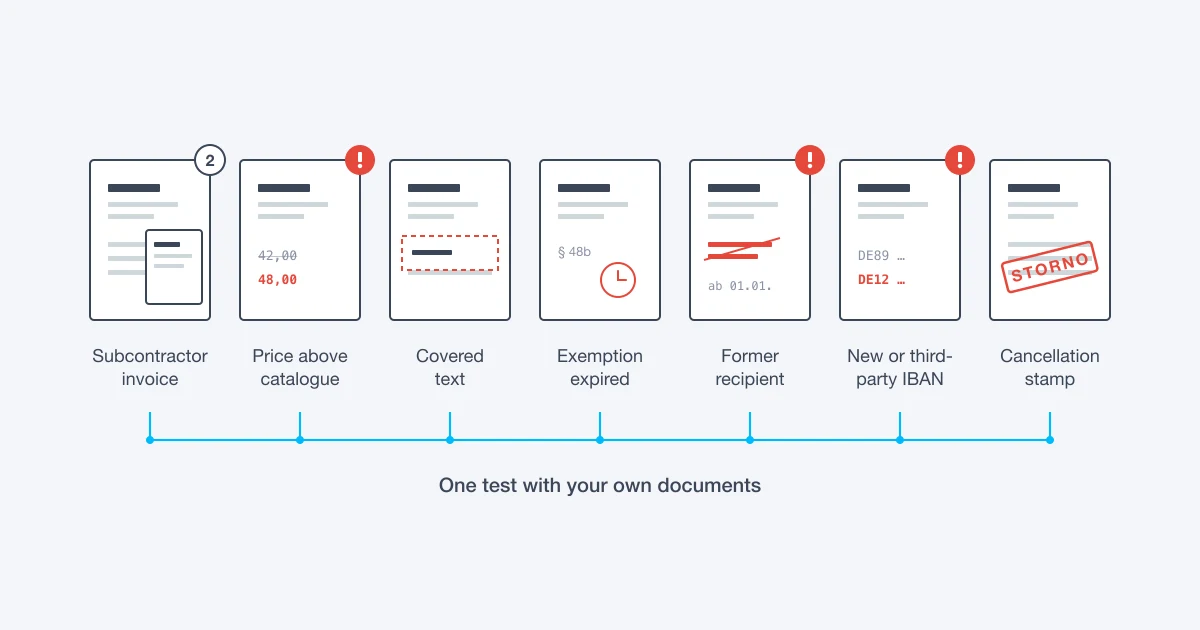
Some invoices are read correctly and still must not be paid. A misread invoice is often caught when it is posted. An invoice that is read correctly but must not be paid, by contrast, looks right in every field. With this checklist of seven documents you can test whether your current invoice intake flags such invoices before payment: a subcontractor invoice in an attachment that is billed twice, a line item above the catalogue price, covered text in a PDF, an expired exemption certificate, an invoice to the former recipient, a new or third-party IBAN, and a cancelled invoice.
Pridonu Cube reads your incoming documents with AI and checks them before it hands them over to your ERP system. Cube has a check for all seven documents and states the anomaly and its reason on the case in which it groups related documents. For this, Cube compares prices, recipients and IBANs with your master data and earlier invoices.
How do you use the checklist?
Run the documents through your current invoice intake, starting with the ones you have to hand. For the price catalogue, the invoice recipient and the third-party IBAN, the test needs your master data; for the new IBAN, a few earlier invoices from one supplier. Note for each document whether the anomaly was recognised, with what reason, and where your team sees the alert. Under each point you will find, for comparison, how Cube shows it. Which checks run for you is agreed with you during setup.
1. Is a duplicate subcontractor invoice in an attachment flagged?
When a subcontractor’s invoice is attached to a main invoice, a second invoice for the same work easily slips through. You need: a supplier’s invoice with its subcontractor’s invoice attached, plus the same subcontractor invoice a second time from a different supplier. What should happen: the subcontractor invoice is read on its own and recognised as a duplicate the second time.
How Cube shows it: the subcontractor invoice sits as a document of its own under the main invoice and is checked for duplicates, even if another supplier submitted it.
2. Is a line item above the catalogue price flagged?
A deviation from the agreed price only shows if every line item is compared with the catalogue price valid on the service date. With maintenance across many properties, a small difference repeats on every invoice. You need: a supplier’s price catalogue with its validity and an invoice with a line item that deviates from it. Fictitious example: €42.00 per maintenance visit is agreed, €48.00 is charged. What should happen: the deviation appears on the line item with the difference.
How Cube shows it: the line amount is compared with price times quantity from the catalogue valid on the service date. Where the check is set up as mandatory, your team confirms the price check with a reason before the case moves on.
3. Is covered text in a PDF flagged?
A white box can alter a PDF invoice unnoticed: the old value is invisible on screen and on paper, but in a PDF with a text layer it is often still underneath. You need: a PDF invoice in which a detail, such as an amount, is hidden under a white box and overwritten. What should happen: the old value under the box is flagged.
How Cube shows it: the alert names the page, the covered and the visible text, and highlights the spot in a page preview.
4. Is an expired exemption certificate flagged?
Under German law, businesses that buy construction work without a valid exemption certificate (Freistellungsbescheinigung) must as a rule withhold 15 per cent of the consideration as construction withholding tax (section 48 of the Income Tax Act, EStG); exemption thresholds apply to smaller annual amounts per contractor. You need: an expired exemption certificate from a construction company. What should happen: the validity is shown in the supplier’s master data, and a certificate that has already expired on receipt gets an alert.
How Cube shows it: tax office, tax number, the certificate’s security number and expiry date are read; the supplier’s master data shows whether, according to that date, the certificate is valid, expiring soon or expired.
5. Is an invoice to the former recipient flagged?
The recipient’s name and address are mandatory invoice details under the German VAT Act (section 14(4) sentence 1 no. 1 UStG); incorrect details can put input VAT deduction at risk, where you claim it. You need: your master data with a change of recipient effective from a set date, for example after a change of company name, and an invoice still addressed to the former recipient after that date. What should happen: the deviation from the recipient valid on the service date is recognised.
How Cube shows it: the check runs per legal entity and shows deviations in name or address with the effective date and validity.
6. Is a new or third-party IBAN flagged?
A new IBAN is a well-known pattern in invoice fraud. You need: a few earlier invoices from one supplier and a further invoice with a new IBAN, or an invoice whose IBAN or VAT number is stored for another supplier in your master data. What should happen: your team sees an alert before the invoice goes for payment.
How Cube shows it: the alert names the IBANs known so far or the other supplier. Your team decides whether the case moves on.
7. Is a cancelled invoice flagged?
When an invoice comes in a second time with a cancellation stamp, the original invoice is cancelled and must no longer be paid. You need: an invoice and the same invoice with a cancellation stamp. What should happen: the original invoice is recognised as cancelled.
How Cube shows it: Cube reads the stamp and its date and sets the original invoice to cancelled. If every invoice in the case is cancelled or paid, Cube recommends rejecting the case.
Who decides when Cube flags an anomaly?
If the main invoice in a case is a duplicate, the rule you set up for it applies: Cube holds back the case or rejects it instead of handing it over to your ERP system, and states the reason on the case. Duplicates in attachments, such as the subcontractor invoice, and every other anomaly in this checklist are flagged by Cube as alerts. Your team confirms a check set up as mandatory with a reason. The decision rests with your team.
What else does Cube read and check?
Cube reads every page on its own, splits and groups documents with no need for separator sheets, and assigns them to the document categories you define: from payment reminders, credit notes and invoice deductions to exemption certificates and utility invoices with advance-payment schedules. Cube can read more than 190 fields from an invoice without document training. The checks set up for you compare the details with mandatory invoice details under section 14(4) UStG, your master data and your properties.
Do you have to replace your ERP system for Cube?
No. With Cube Gateway, Cube works as the invoice intake ahead of your ERP system. Cube takes in documents from your email inbox, via SFTP or by upload, as paper scans, PDFs or e-invoices. It checks them, rejects invoices that must not be paid, with a reply to the sender, if you wish, and automatically requests missing invoices from the supplier. It hands over the checked documents via SFTP and the extracted data as a file in your ERP system’s import format. Approval runs either in Cube, up to four-eyes approval, or as usual in your ERP system.
See Cube with your own documents
For a test you receive test access with your own inbox. You do not need to recreate all seven documents: forward a few days’ documents to this inbox as they reach you today, with payment reminders, cover letters and PDF batches, and add whichever documents from the checklist you have to hand. On each case you see what Cube recognised and with what reason. In the test access, too, Cube runs in data centres in Germany; the AI processes your documents in the EU and does not store them.
Request test access →Nikolai Panasenko, Managing Director of Pridonu GmbH
Please note: this article reflects the legal position and administrative guidance as at the date stated and is no substitute for tax or legal advice.